

Beethoven was born on December 16, 1770
Recommended music videos for initiation to classical music


Ludwig van Beethoven (1770-1827), along with Bach and Mozart, forms part of the trio of giants of Western music. Born on December 16, 1770, in Bonn , his Flemish father attempted to showcase him as a second Mozart , though this proved a notable failure. Despite this, from the age of nine, the organist Christian Gottlob Neefe captivated him with the study of Bach , whose influence he would always hold dear. In 1787, he moved to Vienna intending to study with Mozart , but his mother's death forced him to return to Bonn a few days later. After five years, he returned to Vienna, where he was able to study with Haydn and Salieri . However, his career as an excellent pianist was cut short by the deafness that struck him the following year, leaving him completely unable to play.
The catalogue of Beethoven's works . There are 138 musical works composed by Beethoven , arranged by numbers known as opus ("work" in Latin) or its abbreviation op. , assigned by the composer's publishers during his lifetime. In addition, there are another 205 works without opus numbers that were published after the composer's death. These works were assigned WoO numbers (Werke ohne Opuszahl, "works without opus numbers"). This catalogue was first compiled by Georg Kinsky and Hans Halm (Das Werk Beethovens) in 1955.
A bagatelle (from the Italian *bagatella*) is a short, agile musical composition, unpretentious, originating from the Romantic movement and generally of a "mellow" character. The name *bagatella* literally means "a short, unpretentious instrumental composition," referring to the light style of the piece. Its form is usually A-B-A, with a final coda. Although bagatelles are generally written for solo piano, they have also been written for piano four-hands and other instruments, including choirs, unaccompanied.
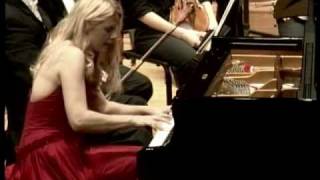
Für Elise. The work we present today is a bagatelle written for solo piano and one of Beethoven 's most popular pieces. The score was made public 40 years after his death, after his manuscript was discovered among the papers of a former student. It seems there was a misunderstanding due to the difficulty of reading the title, which read "Fur Therese " instead of " Fur Elise ," so the work should be titled Für Therese .
Today it is performed by Valentina Lisitsa (1973), a Ukrainian pianist who has lived in the USA since 1991. She began studying piano at the age of three, later enrolling at the Kyiv Conservatory where she met her husband, Alexei Kuznetsoff , also a pianist. Lisitsa has cultivated her audience through her own YouTube channel, for which she has recorded numerous performances, making her currently the most-viewed classical concert pianist on the internet.
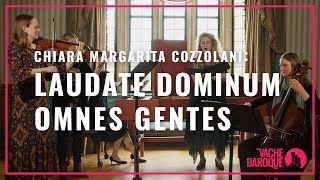
Margarita Cozzolani (1602-1676/8) was born into a wealthy family, and it is believed that her musical education was provided through one of the two choirs that performed for local families and dignitaries. At the age of 18, she became a nun and entered the Benedictine monastery of Santa Radegonda in Milan . Her talent as a composer and performer was renowned in the area, making the monastery one of the city's main musical attractions. Sadly, some of Cozzolani 's works were lost in World War II , but from those that survive, it is clear that she was a highly talented composer who wrote not only spiritual but also secular works. Her compositions were all vocal, ranging from solo monodies to full-throated vespers. What is so impressive, given that she spent her entire adult life in a monastery, is the profound knowledge and understanding of contemporary compositional techniques demonstrated in her works. In the last stage of her life, Cozzolani composed less frequently due to her duties as prioress and abbess. Fortunately for us, thanks to the publications she produced during her lifetime, her compositions became known outside her monastery, and thus have (mostly) survived for our enjoyment.
Today we are delighted to welcome back soprano Hilary Cronin , harpsichordist Asako Ogawa , and baroque cellist Jenny Bullock , who are joined by violinists Christiane Eidsten Dahl and Emma Lake . Video and audio: Ben Tomlin Productions . (Excerpt from the video's footnote)
Joly Braga Santos (Lisbon, May 14, 1924 – Lisbon, July 18, 1988) was a Portuguese classical composer and conductor. He studied violin and composition at the Lisbon National Conservatory , where he was a pupil of Luís de Freitas Branco . After World War II , he studied conducting abroad with Hermann Scherchen and Antonino Votto , and composition with Virgilio Mortari . His musical style evolved from a marked modal tendency in his youth to greater chromaticism in his later years. He wrote six symphonies, three operas, chamber music for various instrumental ensembles, film music, and choral music to texts by various Portuguese and Spanish poets, from Luís de Camões to Garcilaso de la Vega . In 1981, he was appointed Commander of the Order of Santiago of the Sword . He died of a stroke in 1988.
A wind quintet is a group of five instrumentalists (mostly flute, oboe, clarinet, French horn , and bassoon ). Unlike the string quartet , whose sound is very homogeneous, the instruments of a wind quintet differ considerably from one another in timbre and technique. The modern quintet originated from the group sponsored by Joseph II of Habsburg in 18th-century Vienna : two oboes, two clarinets, two French horns, and two bassoons. The quintets composed by Anton Reicha and Franz Danzi definitively established the genre: flute, oboe, clarinet, French horn , and bassoon . Although they declined during the second half of the 19th century , they regained popularity in the 20th century .
Scherzino is the diminutive form of "scherzo" in Italian, which means "joke," "joke," or "fun." In music, a scherzo or scherzino is a musical section or movement, usually in triple meter (ABA), characterized by a fast, lively, and often humorous character. It is similar to an allegro, but with a more playful and rapid pace.
Today we offer the Scherzino of the Joly Braga Santos Quintet performed by Manuel Luís Cochofel (flute), Frederico Fernandes (oboe), Paulo Bernardino (clarinet), Ricardo Conde (horn) and Gonçalo Pereira (bassoon).
John Philip Sousa (Washington, November 6, 1854 – March 6, 1932), popularly known as the King of Marches , was an American composer, Marine, and musical director , particularly known for his compositions of military marches. He was born in Washington , D.C., the son of John Antonio Sousa (born in Seville of Portuguese descent and a Spanish mother) and Maria Elisabeth Trinkhaus (born in Fränkisch-Crumbach, Germany). He learned to play the violin at age six, and when he turned thirteen, his father, a trombonist in the United States Marine Corps band, enrolled him in that branch of the armed forces as an apprentice. Soon after, John ran away from home to play in a circus band. He eventually served in the Marine Corps for seven years, until 1875, learning to play all the wind instruments while maintaining his violin skills. Several years later, he left his apprenticeship to join a theater orchestra. There he learned to conduct, and he returned to the U.S. Marine Corps Band as conductor in 1880. In 1892, he formed his own band, the Sousa Band , with which he toured extensively throughout the United States and Europe. Sousa always avoided conducting his band on radio broadcasts, as he disagreed with losing direct contact with his audience. In 1929, he was persuaded to do so, and his radio programs quickly became a success. Sousa is buried in the U.S. Congressional Cemetery in Washington, D.C.
The Washington Post March was composed by John Philip Sousa in 1889. In 1889, the owners of The Washington Post newspaper commissioned John Philip Sousa , then director of the United States Marine Corps Band, to compose a march for the awards ceremony of their musical competition. Sousa 's creation, "The Washington Post March," was premiered at the ceremony on June 15, 1889, and became a very popular piece. The phenomenon led a British journalist to dub Sousa the "king of marches." Sousa is honored at The Washington Post building for his contribution to the newspaper and to the United States .
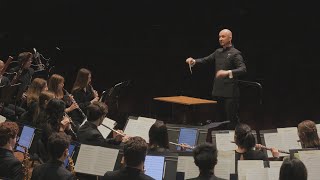
This well-known march is written in a standard structure: AABBCCDCDC, in 6/8 time, an adaptation of the two-step rhythm common at the time. Today, the University of Michigan Symphony Band, conducted by Maestro Jason Fettig, presents it to us.
Recommended classical music videos
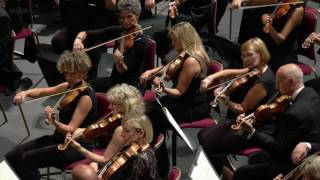
Beethoven 's musical legacy comprises 32 piano sonatas, numerous works for chamber ensembles, piano and violin concertos, incidental music, sacred music, and, above all, nine symphonies that occupy the zenith of music history . To better understand this legacy, we can divide it into three stages of continuous renewal and refinement: A) Up to 1802. Classical period . This period includes his first ten piano sonatas, the first six string quartets, the septet, the first two symphonies, and the first two piano concertos. B) 1803-1814 . Romantic period . At the height of his artistic maturity and with absolute control of formal structure and lyricism, he composed the symphonies from the 3rd to the 8th, his opera Fidelio, his piano concertos 3rd, 4th, and 5th, the violin concerto, the triple concerto, the piano sonatas "Moonlight" and "Appassionata," the Kreutzer Violin Sonata , and others. From 1815 until his death , he innovated with a more intense musical language, employing bolder harmonic and structural treatments: five final piano sonatas and five final string quartets, Symphony No. 9 with the addition of soloists and chorus, the Missa Solemnis , and others.
Symphony No. 9 in D minor, Op. 125, also known as the "Choral" Symphony, is the last complete symphony by the German composer Ludwig van Beethoven . It is one of the most transcendent, important, and popular works in music and art. The final movement caused a sensation in its time due to the inclusion of a vocal quartet and mixed choir, something unprecedented at the time; this movement has also become a symbol of freedom. In 2001, the original score of the symphony was inscribed on UNESCO's Memory of the World Register , where it forms part, along with other outstanding monuments, of humanity's spiritual heritage.
Structure . The symphony has four movements: I (0'06") ALLEGRO MA NON TROPPO, UN POCO MAESTOSO, in D minor. The symphony begins powerfully, with a main theme that unfolds in thrilling scales and variations, with later interludes for lyrical moments, again interrupted by the titanic intensity of the composition. II (14'50") SCHERZO. MOLTO VIVACE, in D minor – PRESTO, in D major . The second movement is described by some critics as "hell in flames," due to its forcefulness and speed, majestically softened in the recapitulation. III (26'41") ADAGIO MOLTO E CANTABILE, in B-flat major – ANDANTE MODERATO – TEMPO PRIMO – ANDANTE MODERATO – ADAGIO – LO STESSO TEMPO. The third movement, although serene, leads firmly into what will be the fourth movement, which contains an easily recognizable, world-famous, and original melody by Beethoven . IV (39'13") FINALE. RECITATIVE (PRESTO – ALLEGRO MA NON TROPPO – VIVACE – ADAGIO CANTABILE – ALLEGRO ASSAI – PRESTO: O FREUNDE) – ALLEGRO ASSAI: FREUDE, SCHÖNER GÖTTERFUNKEN – ALLA MARCIA – ALLEGRO ASSAI VIVACE: FROH, WIE SEINE SONNEN – ANDANTE MAESTOSO: SEID UMSCHLUNGEN, MILLIONEN! – ADAGIO MA NON TROPPO, MA DIVOTO: IHR, STÜRZT NIEDER – ALLEGRO ENERGICO, SEMPRE BEN MARCATO: (FREUDE, SCHÖNER GÖTTERFUNKEN – SEID UMSCHLUNGEN, MILLIONEN!) – ALLEGRO MA NON TANTO: FREUDE, TOCHTER AUS ELYSIUM! – PRESTISSIMO, MAESTOSO, PRESTISSIMO: SEID UMSCHLUNGEN, MILLIONEN! PRESTO ALLEGRO TEMPO. The movement begins with brief recapitulations of the previous movements. Finally, the bass bursts in with a call: "Friends, not in those tones...", after which the melody based on the ode is heard, first through the orchestra and then with the chorus. When the chorus enters, it generally does so homophonically. It constitutes a magnificent musical architecture with diverse textures ranging from recitative to double fugue, including soloists, choir, and so on.
Today it is offered to us by soprano Erin Wall , mezzo-soprano Sonia Prina , tenor Simon O'Neill and bass Alexander Vinogradov with the CBSO Choir , the BBC National Choir of Wales and the BBC National Orchestra of Wales , all conducted by the Chinese maestro Xian Zhang .
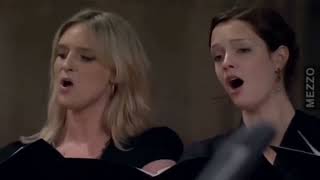
Henry Purcell (1659-1695) is considered one of the greatest English composers in history. He wrote all kinds of choral and instrumental works, both sacred and secular, among which the opera Dido and Aeneas shines . After his father's death, and at his uncle's urging, he was admitted to the King's Chapel Choir, where he began his early studies. At the age of 17, he was appointed assistant organist of Westminster Abbey; at 23, organist, at which point he composed only sacred works for six years until, from 1689 onwards, he began writing operas. His work shows French and Italian influences within what would become a distinctive British Baroque style. He died at the age of 36, at the height of his career.
Purcell's catalogue of works comprises a total of 861 works and was compiled by Franklin B. Zimmerman , identifying his works with a Z.
Music for the Funeral of Queen Mary is a funeral cantata written by Purcell for the funeral of Queen Mary II of England in March 1695; the cantata is structured in seven movements: I (00:00) MARCH IN C MINOR .-. II (01:53) FUNERAL SENTENCE "MAN WHO IS BORN" .-. III (08:10) CANZONA .-. IV (09:03) FUNERAL ORATION "IN THE MIDST OF LIFE" .-. V (15:00) CANZONA .-. VI (17:08) FUNERAL ORATION "YOU KNOW, LORD, THE SECRETS OF OUR HEARTS" .-. VII (19:11) MARCH IN C MINOR.
In the video we present today, it is maestro Jean Tubery who conducts the Ensemble La Fenice .
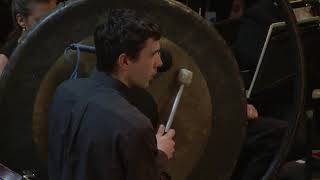
Béla Bartók (1881-1945), a Hungarian pianist and composer, extensively researched the folklore of his country and was one of the founders of ethnomusicology . At the age of five, he began his musical studies with his mother, a piano teacher. At eleven, he gave his first concert, performing a work by Beethoven and one of his own compositions from two years prior. Shortly afterward, the family moved to Pozsony, where he met Ernő Dohnányi . Together they moved to Budapest , where he studied composition while continuing his piano studies. There he met Zoltán Kodály, with whom he undertook a profound study of Hungarian folklore (collecting thousands of songs from peasants), which he then applied to his own compositions. He wrote piano music, chamber music, two cantatas, a Concerto for Orchestra, two rhapsodies for violin and orchestra, two violin concertos and one for viola, three piano concertos, an opera, and two ballets.
Today we offer his Concerto for two pianos, percussion and orchestra structured in three movements: I (0´10´´) ASSAI LENTO - ALLEGRO MOLTO .-. II (13´55´´) LENTO, PERO NO DEMASIADO .-. III (20´08´´) ALLEGRO NO DEMASIADO.
This concert is conducted by Vladimir Jurowski (1972), a Russian conductor, son of conductor Mikhail Jurowski and brother of conductor Dimitri Jurowski . Vladimir began his studies in Moscow until 1990, when his father moved the family to Germany for professional reasons. He completed his studies in composition and conducting in Dresden and Berlin . In 1997, he joined the Komische Oper Berlin as assistant conductor and became principal conductor the following year. In 2007, he was appointed principal conductor of the London Philharmonic Orchestra . He is currently the principal conductor of the Berlin Radio Symphony Orchestra .

Punjabi music reflects the region's traditions associated with the Punjabi language. Punjab is currently divided into two parts: East Punjab , in India , and West Punjab , the most populous province in Pakistan . Punjab boasts diverse musical styles, ranging from folk and Sufi to classical music, particularly Patiala gharana . Contemporary Punjabi music tends to incorporate more modern sounds of hip-hop and R&B . While this musical style is obviously most popular in Punjab , it has gained popularity throughout the subcontinent and in areas with large Punjabi diaspora populations, such as Canada, the United Kingdom , and the United States .
Dolly Guleria is a renowned Punjabi folk singer, born in Bombay, India , on Baisakhi , according to the traditional calendar. She is the daughter of Surinder Kaur , a popular singer. At the age of five, Dolly learned Manipuri and Bharat Natyam music at the Triveni Kala Sangam in Delhi and began her classical music training at the age of seven at the Gandharva Maha Vidyalaya Delhi , where she also learned Kathak dance. She performed her first solo song on All India Radio in 1967 as an amateur Punjabi singer. In 1970, she married and became a mother, having a daughter and two sons. After settling into motherhood, her husband encouraged her to continue her classical music training to apply the same singing technique to both classical and popular music.
Sunaini Sharma belongs to the third generation of musicians: her mother is Dolly Guleria and her grandmother, the renowned Punjabi singer Surinder Kaur , also known as the "Nightingale of Punjab." She is an independent researcher, ethnomusicologist, and cultural conservationist. Sunaini holds a master's degree in English Literature from Panjab University in Chandigarh and an MBA in Human Resources .
Recommended music videos for all tastes

Salsa is a danceable musical genre resulting from the synthesis of Cuban son and other Caribbean and American musical genres such as jazz and blues . Salsa became a commercial success thanks to musicians of Puerto Rican origin in New York in the 1960s, and to the work of its principal architect, the Dominican Johnny Pacheco , although its roots go back decades earlier in countries of the Caribbean basin. Eventually, salsa spread throughout Latin America , giving rise to numerous regional variations. Despite this, although Cuban son is the backbone of salsa , the fundamental element in the emergence of salsa is the role of Puerto Rican musicians and their culture, both on the island of Puerto Rico and in their New York diaspora.
In this video Kyle Johnson offers us an arrangement, salsa version, of the first movement of Beethoven 's Fifth.
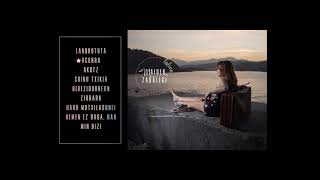
Maider Zabalegi Galardi (born in Oiartzun, Gipuzkoa ) is a Basque singer and songwriter. At the age of 14, she formed a trikitixa duo with Alaitz Telletxea , called Alaitz eta Maider , which achieved great success in the late 1990s. They released three albums before retiring from performing in 2004. After a decade, in 2017 she launched a new project and released her first album, Zuei , in March.
In 2019 he published his second album, Bidean, which today we offer: 1 (0´00´´) Lanbrotuta .-. 2 (2'46'') Agurra .-. 3 (6'45'') Akotz.-. 4 (10´45´´) Soinu txikia .-. 5 (14´35´´) Bidezidorrean .-. 6 (17'52'') Zirrara .-. 7 (21´15´´) Haur motxiladunei .-. 8 (23'47'') Hemen ez bada, they have .-. 9 (27´29´´) Min bizi.

Eric Clapton (Ripley, England, March 30, 1945) is a British rock and blues guitarist, singer, and songwriter, best known for his masterful electric guitar playing as a member of the legendary English rock band Cream . Nicknamed " Slowhand ," he is a three-time inductee into the Rock and Roll Hall of Fame : as a member of The Yardbirds and Cream , and for his solo career. Many critics consider him one of the most respected and influential figures in popular culture history.
He appears at number 2 on Rolling Stone magazine's list of "The 100 Greatest Guitarists of All Time" and at number 55 on their special "Immortals: The 100 Greatest Artists of All Time" issue. In addition, in 2005, Guitar World magazine included five of his songs among the greatest guitar solos of all time. Some of his biggest hits include " Layla " from his time with Derek and the Dominos , " Sunshine of Your Love" with Cream , " Tears in Heaven ," dedicated to his late son Conor and composed with Will Jennings , and "For Your Love" with The Yardbirds , his first major hit.

Nicki Nicole (Rosario, August 25, 2000) is an Argentine singer and songwriter of rhythm and blues, hip-hop, reggaeton , and urban pop . Born in the city of Rosario, Santa Fe , into a middle-class family (she has two brothers and a sister, and is the youngest) of Italian descent, she showed an interest in music from a young age. In 2019, she rose to fame with the single " Wapo Traketero ," which garnered millions of views on YouTube in a short period after its release. The song became a viral phenomenon, entering Billboard's "Argentina Hot 100" chart. In August of that same year, she gained further national and international recognition with the release of her music session with producer Bizarrap .
In November of that year, he released his first studio album, Recuerdos , featuring songs like "Años luz," "Shorty," and "Plegarias," among others. In 2020, he collaborated with Trueno and Bizarrap on the single "Mamichula," which garnered over four hundred million views on YouTube . The following year, he released his second studio album, Parte de mí . In May 2023, he released his third album, Alma , which includes collaborations with artists such as Young Miko, Rels B, YSY A, and Milo J. His international tour took him to several countries, including Morocco, Spain , and the USA . In November 2024, he released his fourth album, Naiki , which reflects his return to his musical roots. This album features collaborations with Duki and Khea . She states that she is very clear that it is thanks to women in the past who paved the way for them to be considered and given the same attention as men.
Recommended peculiar videos
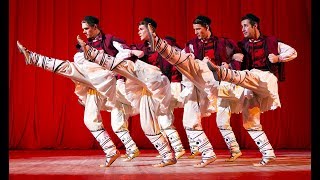
Macedonia is a pivotal and powerful center of Balkan music, heavily influenced by its Byzantine and Ottoman past, as well as the extraordinary blend of other nationalities. Along with Greece and Bulgaria , it boasts one of the greatest rhythmic diversitys in Europe , particularly in its use of compound rhythms ; all of this is reflected in its incredible folk music and dances. These patterns are often subdivided into groups of two and three beats; for example, a 7/8 pattern might be divided into 3-2-2, 2-2-3, or 2-3-2. Ideally, the beat is in eighth notes, but often the tempo is doubled and must be counted in sixteenth notes; that is, in the case of a 7, it would be 7/16, which further complicates rhythmic perception. (Excerpted from an article by Mucume )
Igor Moiseyev (1906-2007) was a Russian choreographer and dancer who studied at the Bolshoi Theatre Ballet , where he worked and even directed acrobatic dances in Moscow's Red Square. In 1930, the government placed him in charge of a new dance company, the Igor Moiseyev Ballet, with which he created nearly 200 choreographies. Today, the Igor Moiseyev Ballet is one of the world's leading ballet companies, successfully blending the spontaneity of folk dances with the academic rigor of classical ballet.
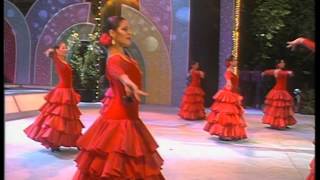
Gerónimo Giménez (Seville, 1854 – Madrid, 1923) was a Spanish composer and conductor, primarily known for composing zarzuelas, leaving behind notable works such as La tempranica and La boda de Luis Alonso . He began his musical studies with his father and later continued them in Cádiz with Salvador Viniegra . A child prodigy, at the age of 12 he joined the Teatro Principal in Cádiz as first violinist. By 17, he was already directing an opera and zarzuela company and received a scholarship to study violin and composition in Paris . In 1885, he was appointed director of the Teatro Apolo in Madrid ; shortly thereafter, director of the Teatro de la Zarzuela , and later, director of the Sociedad de Conciertos , a position he held for 12 years. He died in Madrid on February 19, 1923.
The Wedding of Luis Alonso ( or The Night of the Confinement) is a one-act zarzuela (a short, farcical play) divided into three scenes, written in verse, with music by Gerónimo Giménez and a libretto by Javier de Burgos y Larragoiti . It premiered at the Teatro de la Zarzuela in Madrid on January 27, 1897.
Its instrumental interlude is probably the most popular in the zarzuela. Today, the Alhambra Ballet presents it in a choreographed version.
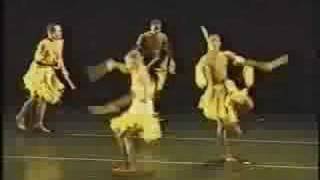
The maculelé is a folk stick dance of Afro-Brazilian origin, where a number of people gather in a circle called a roda . Sticks called grimas and skirts made of dried grass are needed. To dance, a circle of people is formed; each person carries a pair of long sticks, traditionally made from the wood of the Brazilian biriba tree. The people in the circle begin to rhythmically strike the sticks together; the leader sings, and the people in the circle respond by singing along to the refrain. The leader then signals the start of the dance. It appears that the dance originated during the era of slavery in Brazil , where enslaved people on sugarcane plantations would collect and dance the maculelé to express their anger and frustration at being slaves.
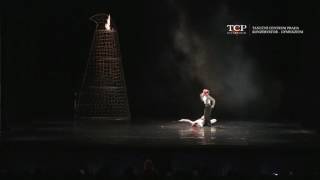
Beethoven 's Creatures of Prometheus is a ballet in two acts, premiered in 1801 and considered the first large-scale dramatic ballet. The story, by Salvatore Viganò (1769–1821), a dancer and poet, tells of Prometheus , a demigod of sublime spirit who regenerated the human race through science and the arts; as protector of human civilization, he stole fire from the gods to bring it from Mount Olympus to Earth.
Today's version is presented by the Prague Dance Centre with the Smíchov Chamber Philharmonic .
Recommended music videos for children






Various Wikipedia articles and relevant information on Artificial Intelligence were used to prepare these texts.
The texts of Videomusicalis are written in Basque, Spanish and English.